
Specification-Driven Development: The Future of Software Product Delivery
AI is collapsing the traditional separation between specification, implementation, and documentation.
In this article, we'll explore why traditional software delivery creates alignment problems, how AI enables a specification-first approach, and why this transformation turns software development from a technical craft into a strategic governance challenge.
The Traditional Model
For decades, software delivery followed a predictable waterfall: requirements gathering → design → development → testing → documentation → GTM → launch. Each phase had specialized teams, creating handoffs where context got lost.
The problem isn't just inefficiency, it's also structural ambiguity. When solution definition lacks clarity, organizations push that ambiguity to various teams to independently define, design, and deliver. This creates tribal silos where each team develops its own understanding of what's being built. Knowledge gaps emerge between domains. Documentation becomes stale. And most critically, teams end up understanding and articulating the solution differently, building toward subtly augmented visions of the same product.
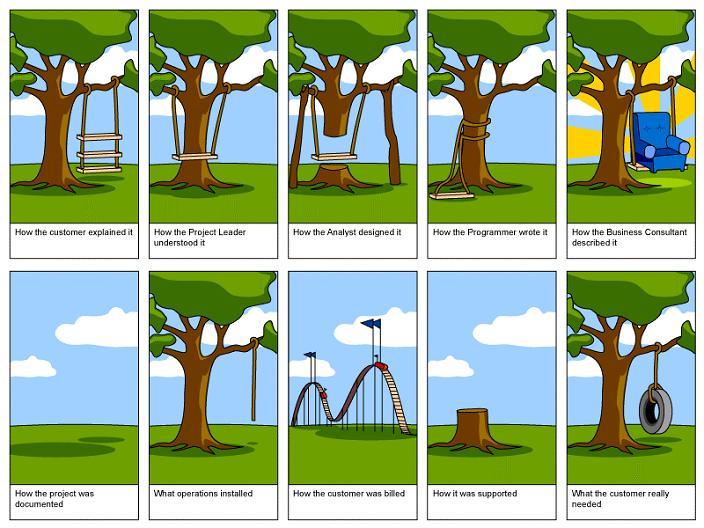
Features take months to reach customers. Not just because of technical complexity, but because teams are constantly discovering and reconciling these misalignments.
AI Changes Everything
AI now allows us to see code, documentation and GTM (among many other things) as translations of data. For software delivery, the data is requirements. Though even those requirements are really translations of market demands.
AI coding assistants can now handle most of the translation work: generating implementation code, creating test suites, writing documentation. Given a clear specification, AI can go from intent to working code.
As our business becomes more enabled to automate software production, product documentation and GTM with AI, our focus begins to narrow on product specification and how that influences the downstream, automated delivery channels.
Specification-Driven Development: A New Model
In specification-driven development, the specification is the single source of truth throughout the product lifecycle:
How It Works
Stakeholders raise issues directly on the specification: questions, proposed changes, edge cases, constraints. Issues become the forum for debate: technical feasibility, security, user experience, legal constraints. When resolved, the specification change becomes the authoritative requirement.
From the new specification revision, AI generates multiple outputs in parallel: the AI-Delivery Pipeline handles code generation and automated validation, product documentation updates, and go-to-market materials. Critically, both documentation and GTM can be produced independently of software implementation; they're derived directly from the specification itself.
The specification is living (continuously updated), executable (direct input to code generation), and auditable (every change traced to a specific discussion).
This model requires specifications that both humans and AI can consume: navigable, unambiguous, traceable, and versionable. The issue system becomes the primary interface, with discussions attached to specific specification sections and full audit trails from issue to deployment.
From Coding to Governance
When coding is automated, what remains are decisions and trade-offs: What should we build? How should it behave? What boundaries must we respect? What's the priority?
These are governance questions requiring judgment and negotiation across Product, Engineering, Security, Legal, Architecture, and Finance. In specification-driven development, these stakeholders collaborate directly on the specification, making decisions visible and traceable.
Different Skills Matter
The focus shifts from writing code to writing specifications, from debugging syntax to clarifying requirements, from optimizing algorithms to optimizing trade-offs. The most valuable people can ask the right questions, facilitate cross-domain discussions, write clear specifications, and recognize when AI-generated code misses the intent.
Speed Changes Everything
When "issue resolved" to "feature deployed" shrinks from weeks to hours, you can experiment with real implementations, respond to feedback same-day, and iterate continuously. But this acceleration makes specification quality critical. With incomplete specifications, AI will fill gaps with its own assumptions, producing working software that subtly regresses functionality or changes behavior in ways you never intended. The software functions, but you've lost something you didn't explicitly protect in the spec.
The Hard Parts
Bad specifications can mean anything from poor UX, to lost brand integrity to lawful wrong doing. Writing good specifications require precise yet understandable language to both humans and AI. Transitioning to specification driven development means resolving many of the inconsistencies between knowledge domains (e.g. support and marketing). It means clarifying ambiguities.
There are emerging frameworks for helping establish a specification driven development practice such as Open Spec that works with many AI-driven IDEs and leans on version control like Git to manage revisions in markdown files.
What Comes Next
The real shift is mindset. The specification becomes your most strategic asset: the executable definition of what your product does and why, not just documentation.
With AI resolving software and GTM delivery as the traditional bottleneck, the new bottleneck will shift to how quickly you can make a decision around what to bring to market. Software development is becoming a governance challenge.